G-Accon vs Double: G-Accon gives accounting firms a broader way to manage their financial data. It connects multiple accounting platforms directly to Google Sheets, supports two-way sync and write-back, automates reporting, and consolidates multiple entities in one place.
Double focuses mainly on AI-powered close automation and practice management within the ledger. While some firms may use both, G-Accon covers more of the reporting, consolidation, and data-management work that continues throughout and after the month-end close.
If your firm is comparing G-Accon and Double, this guide shows where G-Accon offers the broader reporting, consolidation, and data-management workflow, where Double’s close automation fits, and how their pricing changes as your client list grows.
TL;DR
G-Accon is a Google Sheets add-on with two-way sync. It pulls live data from QuickBooks, Xero, Sage, FreshBooks, and Xero Practice Manager into spreadsheets, lets your team post journal entries and other accounting data back into the books, and consolidates multiple entities into one report.
Double is a practice-management platform built around AI-powered close automation, bank feed categorization, and AI-generated journal entries and accruals, plus a client portal, CRM, and tax tools.
G-Accon vs Double at a Glance
| Category | G-Accon | Double |
|---|---|---|
| Best For | Reporting, data sync, and multi-entity consolidation in Sheets | AI-powered close automation within a broader practice-management platform |
| Platform | Google Sheets add-on | Standalone app with a client portal |
| Accounting Integrations | QuickBooks Online, Xero, Sage, FreshBooks, Xero Practice Manager | QuickBooks Online, Xero |
| Google Sheets | Native, two-way sync with write-back | Not native (Zapier connection only) |
| Multi-Entity Consolidation | Built in on every plan | Not available, one ledger per client |
| Pricing Model | Per firm, flat monthly tiers ($60 to $450) | Per connected client, per month ($10 to $50) |
What Does G-Accon Do?
G-Accon lives inside Google Sheets, and it connects directly to QuickBooks, Xero, Sage, FreshBooks, and Xero Practice Manager.
Once connected, your team can pull live financial data into a spreadsheet, build custom reports from more than 100 templates, and push changes, including journal entries, back into the accounting system when needed.
The feature that sets G-Accon apart is multi-entity consolidation. If your firm manages clients with more than one entity, or you need to roll up numbers across several companies into one report, G-Accon does that automatically, with support for currency conversion across more than 170 currencies and intercompany eliminations.
A report that used to take a full day of copying numbers between tabs can run in minutes once the sync is set up. Reports refresh on a schedule you set, so a partner opening a client's dashboard on Monday morning sees Friday's numbers, not last month's.
G-Accon is also an Intuit Platinum App Partner, which reflects the depth of its QuickBooks integration, and it holds the same Platinum tier with Xero.
What Does Double Do?
Double is a practice-management platform for accounting firms and bookkeepers, built around the idea of replacing several disconnected tools with one app. Its core module is AI-powered close automation: bank feed categorization, automated journal entry drafting, and accrual calculations that used to take hours by hand.
Beyond the close itself, Double bundles a branded client portal, a client database for tracking accounts, a tax suite with 1099 tracking, and receipt management. Instead of chasing spreadsheets, email threads, and a separate CRM every month, your team works from one dashboard that shows exactly which clients are done, which are stuck, and why, and handles some of the practice's other admin work along the way.
Each client gets their own close checklist, so nothing slips through the cracks when your team is juggling dozens of closes at once. The client portal also cuts down on the back-and-forth emails that usually eat up the last week of every month, since clients can log in and see status updates without asking your team directly.
If your firm wants AI-driven close automation bundled together with a client portal, CRM, and tax tools in one platform, Double is built for that combination.
It is worth noting that Double's deepest automation, accruals and AI journal entries, sits on its top Scale tier, so firms weighing the cost should factor in which features they actually need before picking a plan. For more on how firms benchmark their close speed, see this breakdown of how long month-end close should really take. For more on how firms benchmark their close speed, see this breakdown of how long month-end close should really take.
How G-Accon and Double Fit Into the Month-End Workflow
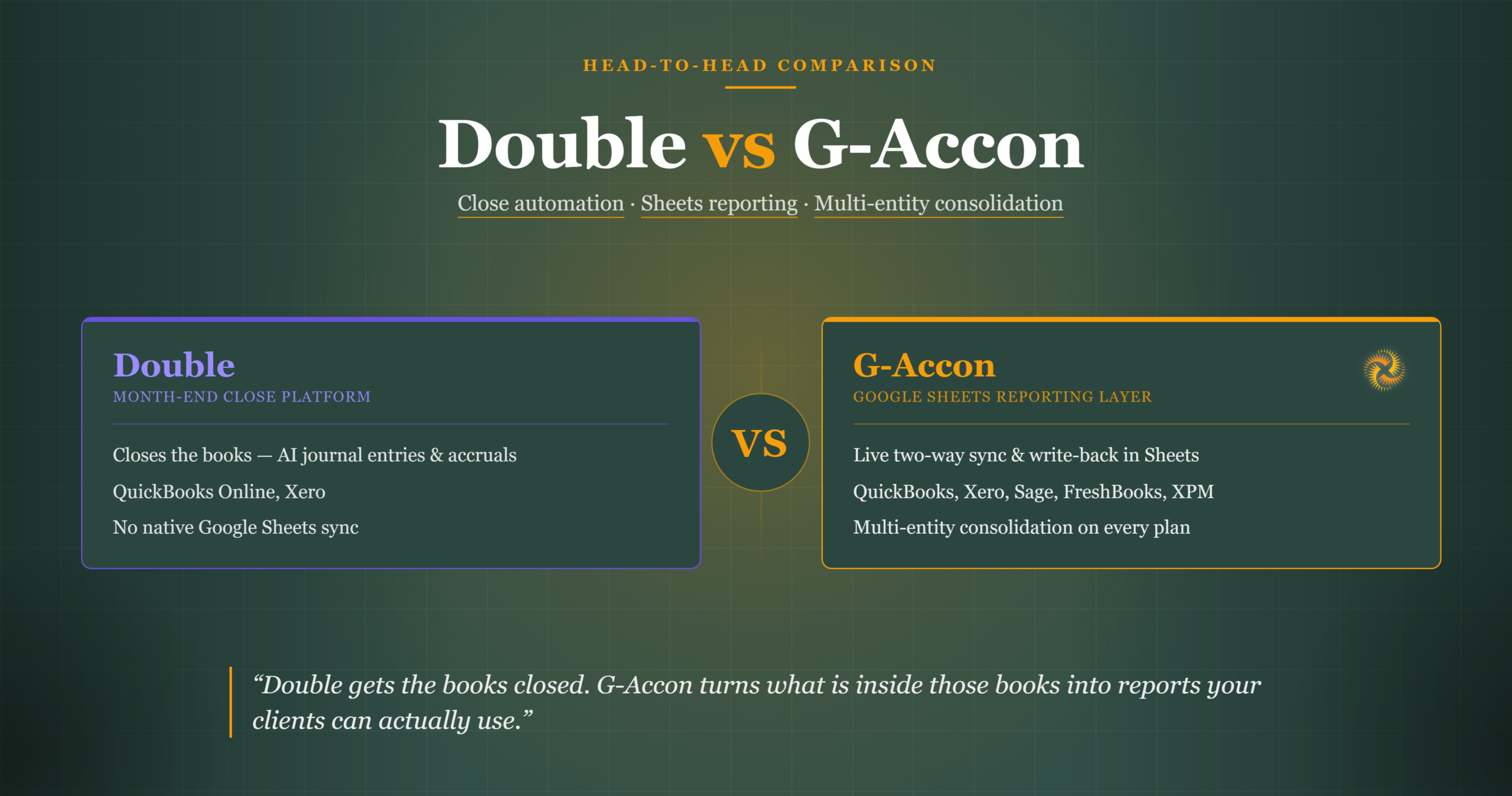
Here is the honest way to think about it: G-Accon takes what is inside your books and turns it into reports, dashboards, and consolidated statements your team and your clients can actually use. Double focuses on running the close itself, plus the practice-management work, client portal, CRM, tax, that surrounds it.
Neither tool tries to do the other's job. G-Accon does not manage close workflows, categorize bank feeds with AI, or offer a client portal. Double has no Google Sheets connection built in and no way to consolidate multiple entities into one view.
If your firm needs both jobs done well, you are looking at two tools working together, not one replacing the other.
Accounting System Integrations
Double's accounting-firm product syncs natively with two systems: QuickBooks Online and Xero. That covers a large share of the market, but it leaves out firms with clients on other platforms.
G-Accon covers more ground. It connects to QuickBooks Online, Xero, Sage, FreshBooks, and Xero Practice Manager. For firms that manage a mixed client base across several accounting platforms, that broader reach matters.
A firm running Double alongside clients on Sage or FreshBooks would need a separate solution for those files, since Double's accounting-firm product does not sync with either one.
This matters most for firms that grew through acquisition or serve clients in different industries. A bookkeeping practice that picked up a construction client on Sage, or a subscription business on FreshBooks, cannot manage those files inside Double at all right now. They would need G-Accon or a similar tool just to bring that data into a usable report.
Google Sheets and Multi-Entity Consolidation: G-Accon's Layer
This is the clearest gap between the two tools. Double has no native Google Sheets integration for its accounting-firm product.
The only way to move data between the two is through Zapier, a third-party automation layer, and even then it does not offer true two-way sync or consolidation.
G-Accon was built around Sheets from day one. Every plan includes multi-entity consolidation, so a firm managing five, twenty, or fifty client entities can roll them into a single report without manual copy and paste. For firms whose real bottleneck is reporting rather than the close itself, this is where G-Accon earns its keep.
Two-Way Sync and Write-Back: What Each Tool Actually Does
Double's sync runs inside its own platform. Changes made in Double update QuickBooks Online or Xero directly, but there is no spreadsheet involved in that loop.
G-Accon's sync works from the spreadsheet itself. Pull data into Sheets, make changes or adjustments, and push them back into the accounting system. That write-back is a core piece of G-Accon's workflow and something Double simply was not built to do.
Pricing: Per-Client vs Per-Firm
G-Accon Pricing
G-Accon bills per firm, not per client, with flat monthly tiers for QuickBooks, Xero, and Sage:
- Business: $60/mo ($50/mo billed annually), up to 3 companies
- Accountant: $150/mo ($125/mo billed annually), up to 25 companies
- Advisor: $300/mo ($250/mo billed annually), up to 50 companies
- Enterprise: $450/mo ($375/mo billed annually), up to 250 companies
Double Pricing
Double charges per connected client, per month, with three tiers:
- Core: $10 per client, per month
- Plus: $25 per client, per month, adds AI financial summaries and receipt management
- Scale: $50 per client, per month, adds accruals and AI journal entries
The cost rises every time your firm adds a client, no matter which tier you are on.
One caveat worth knowing. This pricing covers the QuickBooks, Xero, and Sage tier structure. FreshBooks and Xero Practice Manager run on a separate, lower-priced structure, roughly $40 to $250 per month.
A firm with clients split across more than one accounting platform needs a subscription for each platform, so the flat, per-firm pricing below assumes your client base sits mainly on one system. See the full breakdown on the G-Accon pricing page.
Real Cost Example for a 50-Client Firm
G-Accon Advisor (billed annually): $250/mo flat, assuming all 50 clients run on one accounting platform.
Double Core: roughly $500/mo
Double Plus: roughly $1,250/mo
Double Scale: roughly $2,500/mo
The gap widens as the firm adds clients, since G-Accon's bill does not move whether the firm serves 10 clients or 50, while Double's bill grows with every client added.
See G-Accon's reporting layer in action
Start a 14-day free trial and connect your first client in minutes.
Can You Use Both?
Yes, and many firms running G-Accon and Double side by side do exactly this. G-Accon pulls ledger data into Google Sheets for reporting, dashboards, and multi-entity consolidation. Double runs the close automation and practice management on top of QuickBooks Online, Xero, Sage Intacct, or NetSuite.
The two tools do not compete for the same job, so running both means neither one has to stretch outside what it does best.
Which Should You Choose?
The right answer in the G-Accon vs Double decision depends on where your firm's real bottleneck sits.
Choose G-Accon If...
Your firm needs Google Sheets reporting, works across QuickBooks, Xero, Sage, FreshBooks, or Xero Practice Manager, or manages clients with multiple entities that need to be consolidated into one view.
Choose Double If...
Your clients sit entirely on QuickBooks Online or Xero, your main bottleneck is the close process itself, and you do not need spreadsheet reporting or multi-entity consolidation right now.
Use Both If...
You want an automated close process and flexible, spreadsheet-based reporting on top of it. This is the most common setup for firms with a growing client list.
Security and Compliance
Both tools handle sensitive client financial data, so security is worth a quick look. Double publishes a SOC 2 Type II claim on its security page, though the full report is gated behind a request to its sales team.
G-Accon also holds SOC 2 Type II, with the attestation period and auditor named publicly on its own site, and states it is GDPR compliant for firms handling data from clients in the European Economic Area.
Neither company's public pages should be the only thing you check before signing a contract. If data handling is a deciding factor for your firm, ask each vendor directly for their current compliance documentation.
Frequently Asked Questions
Can I use G-Accon and Double together?
Yes. G-Accon pulls ledger data into Google Sheets for reporting and multi-entity consolidation, and Double manages the close inside QuickBooks Online, Xero, Sage Intacct, or NetSuite. They work on different parts of the workflow, so there is no conflict running both.
Does G-Accon replace month-end close software like Double?
No. G-Accon does not manage close workflows, categorize bank feeds, or offer a client portal. It is a reporting and data sync tool for Google Sheets, built to work alongside close software, not instead of it.
Which is cheaper for a 50-client accounting firm?
G-Accon is cheaper at that scale, assuming clients sit on one accounting platform. Its Advisor plan is a flat $250 per month billed annually. Double's cost depends on the tier, but runs from roughly $500 to $2,500 per month for 50 clients, since it bills per connected client rather than per firm.
Is G-Accon only useful during month-end close?
No. Month-end is one part of what G-Accon supports, not the whole job. Reports refresh on the schedule you set, so dashboards, consolidated statements, and journal entry write-back are available year-round, before, during, and after the close, which is different from a tool built only around the close workflow itself.
The Bottom Line: G-accon vs Double
When you compare G-Accon vs Double, the two tools are not really competing for the same job. G-Accon takes your accounting data and turns it into reports, dashboards, and consolidated statements inside the spreadsheet your team already knows.
Double closes the books with AI-driven automation and wraps a client portal, CRM, and tax tools around that process.
If your firm is growing past a handful of clients, or you manage entities across more than one accounting platform, the reporting gap that a close-only tool leaves open is worth closing.
That's the real takeaway from any G-Accon vs Double comparison, although most firms find the two tools work best side by side, not as a choice between one or the other.