Here's something most small business owners won't admit in public: they're terrified of running out of cash.
Not because their business isn't making money. Not because customers aren't buying. But because predicting cash flow, actually knowing what'll be in your bank account three months from now, feels impossible.
We've seen it a thousand times at G-accon. Business owners are wrestling with Excel at 11 PM on a Sunday. Accountants build custom forecasting models for every single client, then rebuild them when the formulas break. Startup founders staring at blank spreadsheets, trying to create financial projections for investors who expect perfection.
The problem isn't the people. It's the tools.
Most cash flow forecasting tools are either ridiculously expensive enterprise software that takes months to learn, or they're basic Excel templates that fall apart the second you try to customize them for your actual business.
So we built something different. Something that lives where you already work does the complicated math automatically, and doesn't require a finance degree to understand.
We call it G-CashFlow.
What Is G-CashFlow? (And Why It's Different from Every Other Cash Flow Tool)
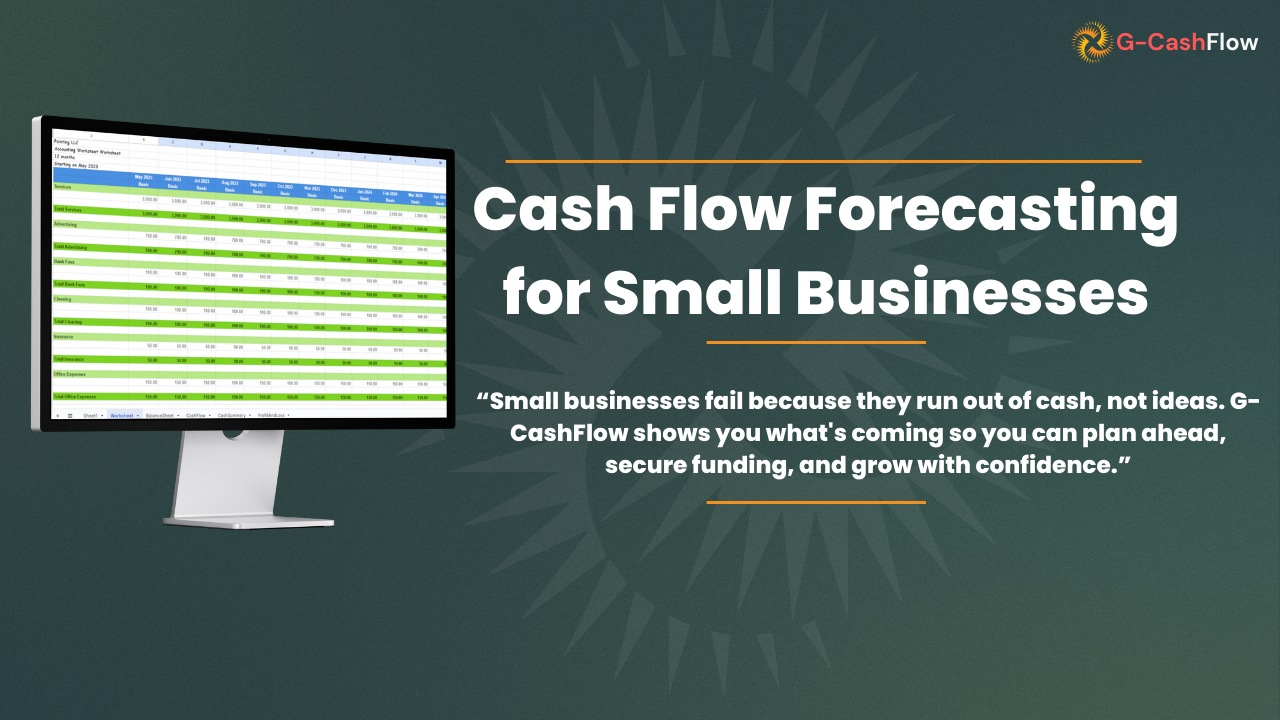
G-CashFlow is a cash flow forecasting tool built directly into Google Sheets. It's designed specifically for small businesses, startups, and the accountants who serve them.
Here's what makes it different: it's a true 3-way forecasting model. That means it automatically generates your Profit & Loss statement, Balance Sheet, and Cash Flow statement simultaneously. They're all connected. Change one assumption, and everything updates together. No hunting for broken cell references. No, wondering why your numbers don't balance.
You enter your assumptions about income and expenses. G-CashFlow handles the rest, creating monthly or quarterly forecasts for up to five years.
And because it's built in Google Sheets, there's no new software to learn. You already know how to use it. You can share forecasts with one click. Your data stays in your Google account, not on our servers or anyone else's.
That matters more than you might think.
Why Small Business Cash Flow Management Is So Hard (And Why Most Businesses Get It Wrong)
Cash flow kills more businesses than bad products or lazy owners.
Think about it. You land your biggest client ever. Amazing news, right? Except they pay on net-60 terms. Your bills? Those are due next week. You don't have a cash problem in three months. You have a cash problem now.
Or you run a seasonal business. You make 70% of your revenue in six months, then barely anything for the other six. Every slow season, you're stressed about whether you saved enough during the busy months.
These scenarios play out in thousands of small businesses every single week. And the frustrating part? They're completely preventable.
Financial forecasting for small businesses isn't about being psychic. It's about seeing what's coming so you can actually do something about it. Need to apply for a small business loan? Banks want to see projections. Planning to hire? You need to know if you can afford payroll in three months, not just today. Considering raising prices? You should probably model what that does to your bottom line first.
The challenge is that most small business financial planning tools are either too simple (basic templates that don't account for real-world complexity) or too complicated (enterprise software that costs more than your monthly rent).
We built G-CashFlow to sit right in the middle, powerful enough to create professional financial forecasts, simple enough to use without a finance degree.
How G-CashFlow Works: Cash Flow Forecasting That Doesn't Eat Your Weekends
Let's walk through how it actually works. No corporate jargon. Just the real process.
Step 1: Start with the chart of accounts
Every business has income and expenses. G-CashFlow comes with a predefined chart of accounts that works for most small businesses immediately. But if you're in construction, retail, professional services, or any industry with specific needs? You can customize it completely. It's your forecast, built your way.
Step 2: Enter your assumptions
This is where you tell G-CashFlow what you expect to happen. When do you expect revenue to come in? What are your monthly expenses? Any seasonal patterns? Payment terms with customers or suppliers? Big purchases coming up?
You're not entering individual transactions. You're entering the patterns. "I expect $10,000 in monthly revenue with 15% growth." "I pay $2,500 in rent every month." That kind of thing.
Step 3: Let the tool do the math
Once your assumptions are in, G-CashFlow generates your three financial statements: Profit & Loss, Balance Sheet, and Cash Flow. Monthly or quarterly, up to five years. Everything stays connected and balanced automatically.
This is where most DIY spreadsheets fall apart. The formulas get complicated. You make one change, and three tabs break over there. With G-CashFlow, the automation handles it.
Step 4: Run different scenarios
Here's where cash flow forecasting gets really useful. What if your revenue grows 20%? What if it drops 10%? What if a major client leaves or your supplier raises prices?
G-CashFlow lets you create multiple scenarios without touching your original forecast. Model the best case, worst case, and most likely case. See what you're actually dealing with before it happens.
Step 5: Track payment schedules
Most forecasting tools treat everything as monthly averages. G-CashFlow is more precise. You can track actual payment schedules, when specific invoices are due, when bills need to be paid. This prevents those nasty surprises where three huge expenses hit the same week.
Step 6: Import existing balances
Already tracking cash somewhere else? You can import your current balances and start forecasting from today. No need to recreate historical data you've already got.
Who Benefits Most from Cash Flow Forecasting Software?
We built G-CashFlow for four specific groups of people who deal with cash flow challenges daily.
Startup Founders and Entrepreneurs
You're building something new. Investors want to see financial projections. So do banks, even for small business loans. G-CashFlow helps you create professional forecasts that show you understand your numbers and have a realistic growth plan.
Instead of throwing together a spreadsheet the night before your pitch meeting, you can build credible projections that account for different growth scenarios, funding rounds, and operating expenses.
Small Business Owners
You're probably wearing a dozen different hats. CFO is one of them, whether you studied finance or not. G-CashFlow gives you visibility into your financial future without turning you into a full-time accountant.
See seasonal cash flow patterns before they become problems. Plan for growth without overextending. Make hiring decisions based on numbers, not guesswork. Sleep better knowing you can cover payroll next month.
Accountants and Bookkeepers
If you serve multiple small business clients, you've probably built custom forecasting models for each one. You've also probably spent hours fixing those models when clients accidentally break formulas or when scenarios change.
G-CashFlow gives you a standardized cash flow management solution you can deploy across your entire client base. Set it up once, customize it for each client's needs, and stop rebuilding models from scratch.
Your clients get better forecasts. You get your evenings and weekends back.
Anyone Writing a Business Plan
Whether you're applying for funding, planning an expansion, or pitching to partners, business plans require financial projections. G-CashFlow makes it straightforward to create the three financial statements every business plan needs.
Real-World Cash Flow Scenarios Where G-CashFlow Makes a Difference
Let's get specific about when this tool actually helps.
Securing a small business loan: Your bank asks for three-year financial projections. You can either pay an accountant $500+ to build them, spend your entire weekend cobbling together spreadsheets, or create professional forecasts in G-CashFlow in a few hours.
Managing seasonal cash flow: You run a business that makes most of its money during specific months, such as landscaping, retail, tourism, whatever. G-CashFlow helps you model exactly how much you need to save during peak season to cover expenses during slow periods.
Testing price changes: You're thinking about raising prices, but worried about losing customers. Model it first. See what a 10% price increase with 5% customer loss looks like versus a 15% increase with 10% loss. Make the decision based on data, not fear.
Planning for growth: You want to hire two people next quarter. When can you actually afford it? Not when you hope you can afford it, when your cash flow forecast says you can sustain the additional payroll expense.
Navigating economic uncertainty: Supply chain issues, inflation, changing market conditions, model all of it. Create scenarios for different economic situations so you have contingency plans ready.
Preparing for tax season: Know when quarterly tax payments will hit and plan for them. No more scrambling to cover a tax bill you forgot about.
Why We Built G-CashFlow in Google Sheets
People sometimes ask us: why Google Sheets instead of standalone software?
Three reasons.
First, you already know how to use Google Sheets. There's zero learning curve for the interface. You're not learning new software; you're using a tool you understand with automation that makes it work better.
Second, collaboration is seamless. Share forecasts with your business partner, accountant, or investors with one click. Everyone can see the same data in real time. No version control nightmares. No emailing spreadsheets back and forth.
Third, your data stays in your control. It lives in your Google account, not on external servers. You own it. You control who sees it. And you can access it from anywhere you can access Google Sheets.
Plus, if you're already using G-accon's other tools to connect Google Sheets with QuickBooks, Xero, Sage, or FreshBooks, G-CashFlow integrates seamlessly. Everything works together.
The G-accon Difference: Why Over 20,000 Businesses Trust Our Financial Tools
G-accon has been automating financial workflows for years. We're a Platinum Intuit Partner and Premium Xero Partner, the highest recognition levels in the industry. Over 20,000 businesses worldwide use our tools to connect accounting software with Google Sheets.
We built our reputation on solving real problems for real businesses. Not selling complicated software that looks impressive in demos but frustrates people in actual use. Our tools do what they're supposed to do, without the hassle.
G-CashFlow is the newest addition to our platform, but it's built on the same principles: make powerful financial tools accessible to everyone, not just enterprises with massive budgets.
Getting Started with G-CashFlow: Free Trial, No Credit Card Required
Ready to stop guessing about your cash flow and start actually knowing?
G-CashFlow is available now as a Google Sheets add-on. You can install it directly from the Google Workspace Marketplace. We're offering a free 14-day trial with no credit card required, just install it and see if it helps your business.
Whether you're launching a startup, managing an established small business, or serving clients who need better financial visibility, G-CashFlow gives you the forecasting power you need without the complexity you don't.
Your cash flow is too important to leave to guesswork. Try G-CashFlow and see what's actually coming instead of hoping it works out.
Visit www.gcashflow.com to learn more and start your free trial today.