Running a business without a clear picture of your cash flows is like driving without a windshield. You might know where you want to go, but you can't see what's coming.
A cash flow forecast template fixes that. It gives you a structured, repeatable way to track money coming in, money going out, and what's left at the end of each period, whether that's a day, a week, or a month.
This guide walks you through everything you need to know: what a cash flow forecast template is, how to use one, which format works best for your business, and how to build a forecast that actually holds up when things don't go to plan. Free downloadable templates for Excel and Google Sheets are included throughout.
Key Takeaways
- A cash flow forecast template helps businesses project future cash inflows and outflows to prevent shortfalls and support financial planning.
- Excel and Google Sheets templates offer flexibility for daily, weekly, monthly, and yearly cash flow forecasting.
- A 12-month cash flow forecast is ideal for annual planning, while a daily or weekly forecast supports day-to-day cash management.
- Accurate cash flow forecasting depends on realistic projections, consistent updates, and tracking both fixed and variable expenses.
- Automating your cash flow model with real-time financial tools reduces manual errors and saves significant time.
What Is a Cash Flow Forecast Template?
Download Our Free Cash Flow Forecast Templates
Whether you need a quick weekly snapshot or a full 12-month cash flow forecast, the right template depends on your planning approach. Below are free download options to suit different business needs and forecasting horizons.
Weekly Cash Flow Template
Track income and expenses day by day across a rolling seven-day period. Ideal for businesses managing tight cash cycles or high transaction volume.
Monthly Cash Flow Template
Monitor monthly cash flows across a rolling 12-month window. Perfect for planning around seasonal changes and tracking long-term trends.
12-Month Cash Flow Forecast
A comprehensive yearly cash flow model covering projected cash inflows and outflows across every month. Built for annual financial planning and lender submissions.
Types of Cash Flow Forecast Templates
There is no single template that works for every business. The right one depends on your industry, payment cycles, and planning horizon. Here is a breakdown of the most common formats.
Daily Cash Flow Forecast Template
A daily cash flow forecast is used when cash positions shift rapidly, as is common in retail, hospitality, or businesses dealing with high volumes of small transactions. It tracks every cash receipt and payment at the day level, giving a granular view of short-term liquidity that weekly or monthly forecasts simply cannot match.
This level of detail is especially useful for businesses managing overdraft limits or negotiating short-term financing. Seeing a daily cash gap three or four days in advance gives you enough time to act, whether that means chasing an overdue invoice or drawing on a credit facility before a payroll run hits.
Weekly Cash Flow Forecast Template
A weekly cash flow forecast template strikes a practical balance between detail and manageability. It groups inflows and outflows by week, making it easier to spot trends without the administrative burden of daily tracking.
For most small and medium businesses, a rolling 13-week forecast, covering roughly one quarter, is the standard approach used by CFOs and finance teams.
Weekly forecasting also helps manage relationships with suppliers and customers. When you can see precisely which week cash is expected to arrive and which week payments are due, scheduling and negotiating become far more straightforward.
Monthly Cash Flow Forecast Template
A monthly cash flow forecast template is the most widely used format for general financial planning. It organizes projected cash flows by calendar month, making it easy to compare periods, identify seasonal trends, and build budget conversations around reliable numbers.
Monthly forecasts are particularly valuable when presenting to boards, lenders, or investors. A clean monthly template, whether in Excel or Google Sheets, shows stakeholders that your business has a clear view of its financial trajectory and enough discipline to plan ahead.
12-Month Cash Flow Forecast Template
A 12-month cash flow forecast covers an entire fiscal year on a monthly basis. It is the go-to format for annual budgeting, loan applications, and long-term financial planning. A well-built 12-month model includes projected cash inflows from sales, client receipts, and investments alongside outflows covering payroll, loan repayments, supplier costs, and overheads.
Most banks and lenders will request a 12-month forecast before approving business financing. Having one ready, built on realistic projections rather than wishful thinking, gives your application a far stronger foundation.
Yearly Cash Flow Template
A yearly cash flow template takes an even broader view, summarizing cash flows across multiple years. This format suits businesses in growth phases, those planning major capital investments, or companies preparing for acquisition or fundraising. It is less granular than a monthly view but essential for communicating long-term cash sustainability to investors and strategic partners.
Excel Template vs. Google Sheets: Which Should You Use?
The two most popular formats for cash flow forecasting are Microsoft Excel and Google Sheets. Both are capable tools. The right choice comes down to how your team works and what level of collaboration you need.
An Excel template gives you powerful formula functionality, advanced charting options, and a familiar interface that most finance professionals already know well.
It is particularly useful for building complex cash flow models with multiple scenarios, creating custom pivot tables, or automating macros. For businesses working offline or handling sensitive financial data that shouldn't live in the cloud, a free Excel template is often the preferred route.
Google Sheets, on the other hand, is built for real-time collaboration. Multiple team members can update a cash flow template simultaneously, comment on specific cells, and view changes as they happen, no version-control headaches, no emailed file attachments. For distributed finance teams or businesses where multiple people contribute to the forecast, Google Sheets is a practical and cost-effective option.
In practice, many businesses use both: a master Excel template for formal reporting and a shared Google Sheets version for ongoing updates. The key is consistency; whichever format you choose, the template should be updated regularly to remain useful.
How to Create a Cash Flow Forecast
Creating a cash flow forecast does not need to be complicated. With a solid template and the right inputs, most businesses can build a working forecast in an afternoon. Here is a step-by-step process to get it done.
Step 1: Choose Your Forecast Period
Decide whether the forecast will cover a daily, weekly, monthly, or yearly period. Short-term forecasts, daily or weekly, are best for day-to-day cash management. Longer-term forecasts, monthly or 12-month, are better suited for financial planning and strategic decisions. Many businesses run both simultaneously.
Step 2: List All Cash Inflows
Start by identifying every source of cash coming into the business during the forecast period. This includes customer receipts, sales revenue, loan proceeds, investment income, government grants, and any other inflows expected. Be specific about timing, enter income in the period when cash is actually received, not when the invoice is issued.
Step 3: List All Cash Outflows
Record every payment leaving the business. Break these into fixed and variable categories. Fixed expenses, rent, salaries, loan repayments, software subscriptions, and insurance are predictable and consistent.
Variable expenses, utilities, raw materials, commissions, and supplier payments fluctuate depending on business activity. Missing either category will skew the entire forecast.
Step 4: Calculate Net Cash Flow
Subtract total outflows from total inflows for each period. The result is your net cash flow. A positive figure means the business is generating more cash than it is spending. A negative figure, a cash shortfall, is a warning signal that needs attention before it becomes a crisis.
Step 5: Calculate the Closing Cash Balance
Add net cash flow for the period to the opening cash balance. This gives you the projected cash on hand at the end of each period. The closing cash balance for one period becomes the opening balance for the next; this is how a rolling forecast maintains continuity over time.
Step 6: Review and Adjust Projections with Real Data
Once the initial forecast is built, compare projections against actual cash flows as each period closes. Look at where estimates were off, identify the reasons, and update future projections accordingly. Over time, this iterative process produces increasingly accurate cash flow forecasting and a much clearer picture of where the business is heading.
How to Use a Cash Flow Forecast Template Effectively
Downloading a free cash flow forecast template is only the first step. Using it well, consistently, honestly, and with enough detail, is what makes forecasting valuable. Here are the practices that separate a useful forecast from one that collects digital dust.
Update the Template Regularly
A cash flow forecast is only as accurate as its most recent update. For weekly forecasts, update at least once a week. For monthly forecasts, review and refresh at the start of each month.
Outdated projections are worse than no projections at all; they give a false sense of certainty that can lead to poor financial decisions at exactly the wrong moment.
Use Historical Data to Ground Your Projections
The most reliable forecasts are built on historical data. Pull actual cash receipts and payments from previous periods to establish realistic baselines. Avoid the temptation to project based on aspirational sales targets; enter what the numbers actually support. Overly optimistic forecasts are one of the most common causes of cash shortages in otherwise healthy businesses.
Track Inflows and Outflows Separately
Keep cash inflows and cash outflows clearly separated in the template rather than netting them together. This makes it easier to spot where cash gaps are forming, whether revenue is running below expectations, or specific expense categories are running hot. A combined figure hides the detail you need to act quickly.
Build in a Cash Buffer
Even with accurate cash flow forecasting, unexpected expenses happen. A supplier raises prices without notice. A key customer delays payment by 30 days. Equipment breaks down. When building the forecast, identify a minimum cash on hand threshold, a cash buffer, and treat dipping below it as an early warning sign, not a crisis.
Cash Flow Forecast Template Example
To make this concrete, here is a simplified monthly cash flow forecast template example. It covers a three-month period and illustrates how projected cash inflows and outflows translate into a closing cash balance.
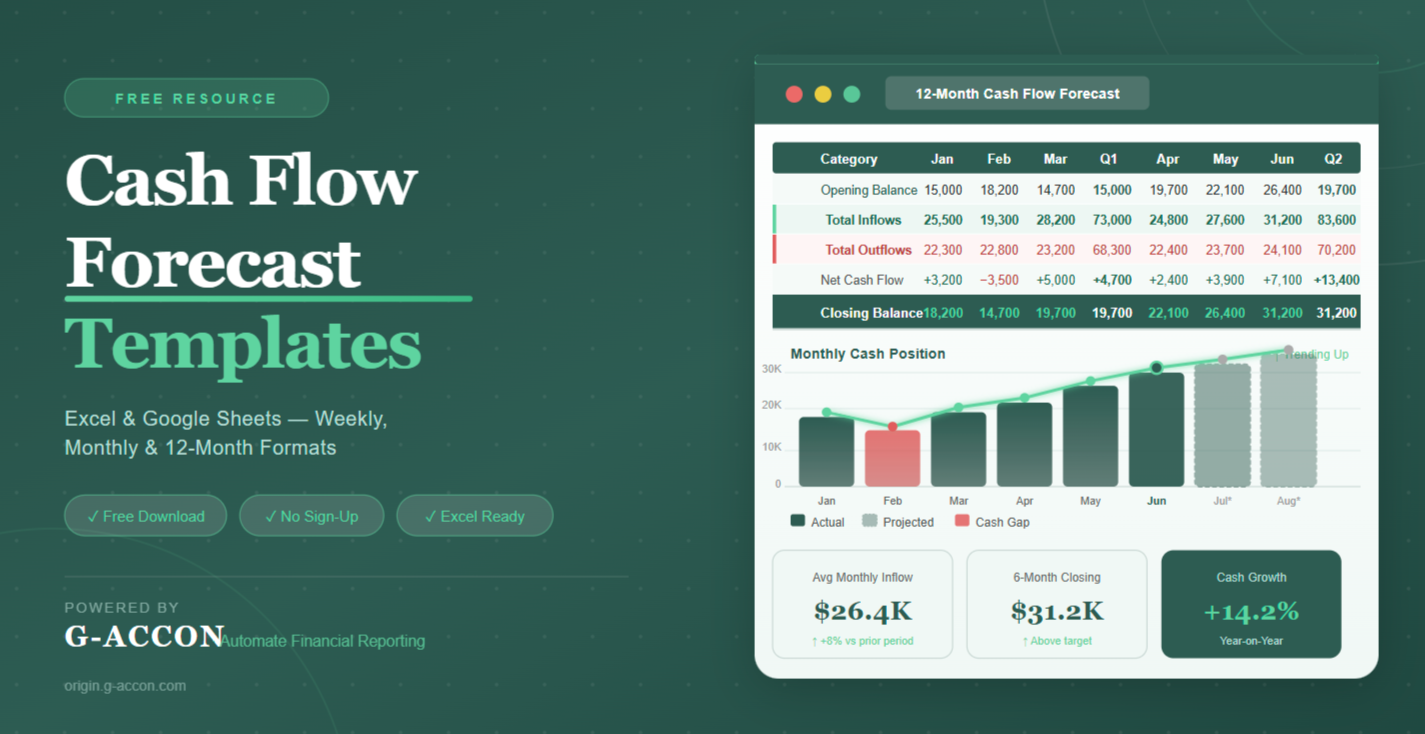
| Category | January | February | March |
|---|---|---|---|
| Opening Cash Balance | $15,000 | $18,200 | $14,700 |
| Cash Inflows | |||
| Customer Receipts | $24,000 | $18,500 | $27,000 |
| Other Income | $1,500 | $800 | $1,200 |
| Total Inflows | $25,500 | $19,300 | $28,200 |
| Cash Outflows | |||
| Payroll | $10,000 | $10,000 | $10,000 |
| Rent & Utilities | $3,200 | $3,200 | $3,200 |
| Supplier Payments | $4,800 | $5,600 | $6,200 |
| Loan Repayments | $2,000 | $2,000 | $2,000 |
| Other Expenses | $2,300 | $2,000 | $1,800 |
| Total Outflows | $22,300 | $22,800 | $23,200 |
| Net Cash Flow | $3,200 | −$3,500 | $5,000 |
| Closing Cash Balance | $18,200 | $14,700 | $19,700 |
Notice that February shows a negative net cash flow of $3,500. In isolation, this looks alarming, but the opening cash balance of $18,200 means the business still has $14,700 in cash on hand at the end of the month.
The forecast doesn't just flag the problem; it shows you have the reserves to absorb it, and that March is projected to recover strongly. That context is exactly what makes forecasting so useful.
Advantages of Using a Cash Flow Forecast Template
Supports Financial Planning and Liquidity Management
Cash flow forecasting helps businesses move from reactive to proactive financial management. Instead of discovering a cash shortfall when bills are already overdue, a forecast gives you days or weeks of advance warning.
That time is valuable. It might mean arranging a short-term credit facility, renegotiating payment terms with a supplier, or accelerating collections from key customers, options that disappear once a crisis has already arrived.
Prevents Cash Shortages Before They Happen
Short-term liquidity problems are among the most common causes of business failure, not because companies are unprofitable, but because cash flows simply aren't timed correctly.
A template surfaces cash gaps weeks in advance, giving finance teams the runway needed to address them before they become emergencies. It also helps identify patterns: if the forecast consistently shows a shortfall in the same week each month, that's a structural problem worth investigating rather than a coincidence to manage around.
Strengthens Relationships with Lenders and Investors
Lenders don't just want to see that a business is profitable; they want to know it can service its debt. A well-maintained cash flow forecast demonstrates exactly that.
Whether applying for a loan, attracting investment, or negotiating extended credit terms with a supplier, showing up with a credible 12-month cash flow model signals financial maturity and reduces perceived risk.
Enables Better Budgeting and Decision-Making
When you can see future cash positions clearly, decisions become far less stressful. Should you hire an additional team member now or wait until Q3? Can the business afford to take on that large project with 90-day payment terms?
Is this the right time to invest in new equipment? A cash flow model provides the financial context needed to make these calls with confidence rather than guesswork.
Disadvantages and Limitations to Be Aware Of
Risk of Inaccuracy if Not Updated
A cash flow forecast is only as good as the data behind it. If the template isn't updated regularly, or if initial estimates were too optimistic, the resulting projections can be dangerously misleading. Businesses that treat a forecast as a one-time document rather than a living tool often end up less prepared for cash gaps than if they had no forecast at all.
Basic Templates May Not Scale with Complexity
For small businesses with simple revenue streams and a handful of expense categories, a basic spreadsheet template works well. For larger businesses managing multiple entities, currencies, and complex supplier networks, a manual spreadsheet becomes a bottleneck. At a certain scale, the time spent maintaining the template exceeds its value, and errors become increasingly likely as complexity grows.
Common Mistakes to Avoid When Using a Cash Flow Template
Even experienced finance teams make predictable mistakes when building and maintaining cash flow forecasts. Knowing what to watch for makes a significant difference in forecast accuracy.
The most common error is failing to include all expenses. Fixed and variable costs both need to appear in the forecast. Businesses often remember payroll and rent, then forget quarterly insurance premiums, annual software renewals, or irregular supplier payments. These gaps accumulate quickly and can throw off an entire quarter's projections.
Another frequent mistake is building forecasts entirely on projected sales figures without accounting for the timing of actual cash collection. A business might close $50,000 in sales in January, but if payment terms are net 60, that cash doesn't arrive until March. Confusing revenue with cash receipts is a common and costly forecasting error, particularly for businesses experiencing rapid growth.
Finally, many businesses build a forecast once and then neglect to update it as circumstances change. A cash flow forecast that isn't refreshed with actual data becomes a work of fiction. The most useful forecasts are those reviewed and updated on a consistent schedule, weekly for short-term forecasts, monthly for longer-range planning.
Manage Cash Flow More Efficiently with Automation
Manual spreadsheets work well for businesses with straightforward financials. But as transaction volumes grow and reporting requirements become more complex, manual cash flow forecasting creates its own problems, version control issues, formula errors, hours spent reconciling data from multiple systems, and forecasts that are already out of date by the time they're finished.
This is where G-Accon comes in. G-Accon connects directly to accounting platforms such as Xero, QuickBooks, Sage, and FreshBooks, pulling your actual financial data into Google Sheets in real time.
That means your cash flow model is always working from live numbers, no manual data entry, no copy-paste errors, and no chasing down figures from separate systems before every reporting cycle.
For finance teams managing multiple entities, G-Accon consolidates data across all of them into a single, consistent view. Reporting that previously took days gets done in minutes.
And because everything lives in Google Sheets, your team gets the familiar spreadsheet interface they already know, just with the manual work removed.
Rather than rebuilding the forecast spreadsheet from scratch each month, G-Accon users can focus on what actually matters: interpreting the numbers, identifying cash gaps early, and making informed decisions with confidence. If your business has grown beyond what a basic template can handle, explore what G-Accon can automate for your team.
Frequently Asked Questions
What is the difference between a cash flow forecast and a cash flow projection?
The terms are often used interchangeably, but there is a subtle distinction. A cash flow forecast typically refers to short-term projections based on known, confirmed inflows and outflows. A cash flow projection tends to cover a longer horizon and relies more heavily on estimated or assumed figures. In practice, most finance teams use both interchangeably to mean any forward-looking view of expected cash positions.
How often should I update my cash flow forecast?
For most businesses, updating a monthly cash flow forecast at the start of each month and reviewing it mid-month provides a good balance of accuracy and effort.
Weekly forecasts should be updated every week. If your business experiences volatile or unpredictable cash flows, more frequent updates are worth the extra time.
Can I use a cash flow forecast template for a startup?
Yes, and for startups, cash flow forecasting is even more important than for established businesses. Without historical revenue data to rely on, startups need to be especially careful about the assumptions they build into their projections.
A conservative, scenario-based approach, forecasting a best case, a base case, and a worst case, gives a more honest picture of financial risk and helps founders make smarter decisions about spending and fundraising timing.
What is included in a 12-month cash flow forecast?
A 12-month cash flow forecast includes projected cash inflows (customer receipts, other income) and cash outflows (payroll, rent, loan repayments, supplier payments, variable costs) for each of the twelve months in the forecast period.
It also tracks the opening and closing cash balance each month, giving a clear view of cash position at every point in the year. Most lenders and investors will expect to see this level of detail when evaluating a business for financing.
Is a free cash flow forecast template enough for my business?
For small businesses and freelancers with manageable transaction volumes, a free Excel or Google Sheets template is more than sufficient. As the business grows and financial operations become more complex, a template alone may struggle to keep pace.
At that point, tools that automate data collection and reporting can provide significantly better accuracy and efficiency, freeing finance teams to focus on analysis rather than data entry.
Start Forecasting Cash Flow with Confidence
A cash flow forecast template is one of the most practical tools any business can have. It does not need to be complicated to be useful; a clean, well-maintained spreadsheet covering the next 12 months provides everything you need to plan ahead, avoid shortfalls, and make informed financial decisions throughout the year.
Download one of the free templates above to get started. Whether you choose a daily cash flow forecast for granular visibility or a 12-month model for annual planning, the most important step is simply to begin.
Consistent use of a cash flow forecast, updated regularly and built on realistic projections, will give your business a financial foundation that very few of your competitors have.
And when your business outgrows manual templates, G-Accon automates the process. Real-time data pulled directly from Xero, QuickBooks, Sage, or FreshBooks keeps your forecast current and ready when you need it most. Learn more about G-Accon's automated reporting tools.