Cash flow forecasting sounds simple until the numbers stop behaving.
You need to know when money will come in, what bills are due first, and whether you can still cover payroll, taxes, rent, and supplier costs if customers pay late.
That is where tools like G-CashFlow and Fathom come in.
Both help businesses forecast cash flow. Both support financial planning. But they are built for different types of users.
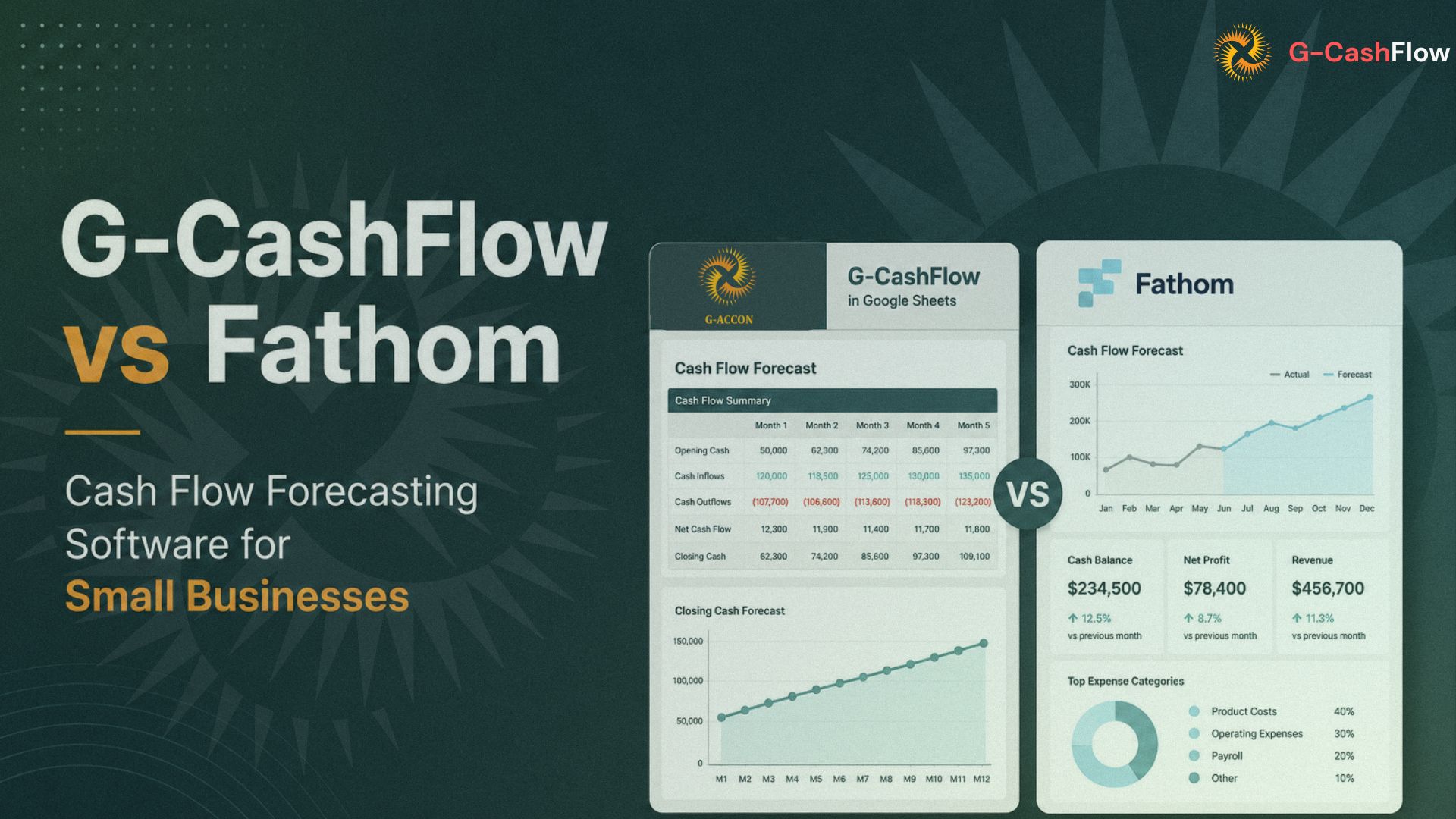
G-CashFlow is a spreadsheet-first cash flow forecasting tool built for Google Sheets. It helps users create Profit & Loss, Balance Sheet, and Cash Flow forecasts while testing scenarios and tracking payment schedules.
Fathom is a broader reporting, analysis, and forecasting platform. It is built for businesses and advisors that need forecasts, dashboards, KPIs, management reports, and financial insights in one place.
So the real question is simple:
Do you need flexible cash flow forecasting in Google Sheets, or do you need a full reporting and advisory platform?
G-CashFlow vs Fathom: Quick Comparison
What Is G-CashFlow?
G-CashFlow is a cash flow forecasting tool for Google Sheets.
That is the first thing to understand.
It is not trying to pull users into a completely new finance system. It works inside the spreadsheet environment that many small business owners and accountants already use.
G-Accon says G-CashFlow offers three-way forecasting directly in Google Sheets. Users can create Profit & Loss statements, Balance Sheets, and Cash Flow reports while comparing scenarios and tracking payment schedules.
That makes it useful for questions like:
- Can we afford to hire next quarter?
- Will we have enough cash after tax payments?
- What happens if a major client pays late?
- Can we build financial projections for a loan or investor pitch?
- How much cash will we have three months from now?
G-CashFlow's Google Workspace Marketplace listing also describes it as a 3-way cash flow forecast Google Sheets tool powered by G-Accon. The listing says it supports payment schedules and lets users create multiple scenarios for their cash flow worksheet.
That is the product's core advantage. It gives users more structure than a homemade spreadsheet, but it keeps the familiar Google Sheets workflow.
What Is Fathom?
Fathom is a reporting, analysis, and forecasting platform. It is not only focused on cash flow forecasting. It also helps users create management reports, analyze performance, track KPIs, build forecasts, and share financial insights.
Fathom describes itself as an all-in-one reporting, analysis, and forecasting solution. Its homepage says it combines reporting, fast cash flow forecasting, and financial insights into one business management tool.
That broader focus makes Fathom useful for accountants, advisory firms, and businesses that need more than a forecast.
For example, a business owner may use G-CashFlow to answer, "Will we have enough cash next quarter?"
But an advisor may use Fathom to answer, "What happened last month, what does it mean, what should the client do next, and how do we present that clearly?"
That is a different job.
Which Cash Flow Forecasting Software Is Better for Small Businesses?
For most small businesses, G-CashFlow is the better place to start. It gives you the core thing you need: a clear cash flow forecast inside Google Sheets. You can test scenarios, review payment timing, and understand what your cash position may look like without moving your planning into a full reporting platform.
If you are still comparing options, this guide to the best cash flow forecasting software for small businesses gives a broader look at the tools worth considering before you choose.
G-CashFlow is also a good fit when the business needs a practical forecast for planning, loan applications, hiring decisions, seasonal cash planning, or investor conversations.
Fathom may be better if the business needs more formal reporting. It is stronger when users need management reports, KPIs, planned vs actuals, dashboards, and financial analysis in one place. Fathom says its forecasting is integrated into Fathom Reporting, which allows users to compare actuals against forecasts by saving forecasts as budgets.
So the simple answer is this:
G-CashFlow is better for small businesses that want spreadsheet-based cash flow forecasting. Fathom is better for businesses and advisors who need forecasting plus polished reporting.
G-CashFlow vs Fathom for 3-Way Forecasting
A 3-way forecast connects three financial statements:
- Profit & Loss
- Balance Sheet
- Cash Flow Statement
This matters because cash flow does not exist by itself. Revenue, expenses, debt, assets, inventory, tax, and payment timing all affect cash.
G-CashFlow is built around this idea. G-Accon says the tool creates Profit & Loss statements, Balance Sheets, and Cash Flow reports inside Google Sheets.
G-Accon's small business cash flow page also says G-CashFlow automatically generates the Profit & Loss, Balance Sheet, and Cash Flow statement together. It says users can enter assumptions about income and expenses, then create monthly or quarterly forecasts for up to five years.
Fathom also supports cash flow forecasting and scenarios. Its cash flow forecasting page says users can build forecasts from scratch, use Quick Start Forecast from accounting data, or link a cash flow forecast to an existing budget.
The difference is the working style.
G-CashFlow feels closer to a spreadsheet model. Fathom feels closer to a reporting and planning platform.
If you want to sit close to the numbers and work inside Google Sheets, G-CashFlow has a clearer fit.
If you want the forecast tied into reports, dashboards, and advisory conversations, Fathom has the stronger setup.
Is G-CashFlow Better Than Fathom for Google Sheets?
Yes, if the main requirement is cash flow forecasting in Google Sheets.
This is probably G-CashFlow's strongest product angle.
Fathom does connect with Google Sheets. Its cash flow forecasting page also lists Google Sheets among the data sources and integrations it supports.
But there is a difference between connecting to Google Sheets and being built for Google Sheets.
G-CashFlow's value is that the forecast lives where many small businesses already work. Users do not have to leave the spreadsheet environment to build assumptions, review numbers, and collaborate with others.
That can be a big deal for accountants and fractional CFOs, too.
Many advisors already have their own planning habits. They may have a preferred way to model payroll, revenue growth, debt repayments, seasonal changes, and tax timing. A fixed dashboard can feel restrictive. A spreadsheet gives them more room to think.
G-CashFlow keeps that flexibility while adding structure.
That is why it works well as a Fathom alternative for Google Sheets users.
Is Fathom Better Than G-CashFlow for Reporting?
Yes, Fathom is stronger for reporting.
Fathom is built for reporting and analysis, not just forecasting. Its website highlights management reporting, financial analysis, forecasting, consolidated reporting, group benchmarking, KPIs, and metrics as core product areas.
That makes it a better fit when the final output needs to be clean, polished, and easy to share.
For example, an accountant preparing a monthly client report may care about more than future cash. They may need to show revenue trends, margins, KPIs, commentary, and actual performance against plan.
Fathom is stronger for that kind of work.
G-CashFlow gives users financial reports, but its main strength is the forecast itself. It is better for planning and modeling inside Google Sheets.
So the reporting comparison is fairly clear:
G-CashFlow helps you build and control the forecast. Fathom helps you present financial performance.
G-CashFlow vs Fathom Integrations: Which Tool Connects Better?
Fathom has the broader integration list.
Fathom says its cash flow forecasting software connects with platforms including Xero, QuickBooks Online, QuickBooks Desktop, MYOB, Excel, Google Sheets, and Access Financials UK.
G-CashFlow's strongest integration story is Google Sheets. The Google Workspace Marketplace listing shows that it works with Google Sheets and is powered by G-Accon.
G-Accon's wider ecosystem also connects accounting tools with Google Sheets, which is part of the reason G-CashFlow fits the G-Accon product line. But for this comparison, Fathom clearly has the broader native integration story across accounting systems and reporting workflows.
That does not automatically make Fathom better.
It means Fathom is better if you need one platform to pull data from several sources and turn it into reports.
G-CashFlow is better if your main goal is to forecast cash flow inside Google Sheets.
G-CashFlow vs Fathom Pricing: Which Gives Better Value?
The better value depends on what the user needs.
G-CashFlow is easier to position as a focused forecasting tool. If the user mainly wants 3-way cash flow forecasting in Google Sheets, paying for a full reporting and advisory platform may be more than they need.
Fathom gives more reporting and analysis features, so its value is broader. If the user needs reporting, KPIs, dashboards, forecasting, and client-facing outputs, then Fathom's wider feature set may justify the cost.
This is the practical way to explain it:
Choose G-CashFlow if you want to pay for forecasting. Choose Fathom if you want to pay for forecasting plus reporting.
Who Should Use G-CashFlow?
G-CashFlow is a strong fit for small businesses that want better cash flow planning without leaving Google Sheets.
It is especially useful for:
- Small business owners who want to see what cash will look like in the next few months
- Startups building financial projections for investors or lenders
- Accountants who want a repeatable forecasting model for clients
- Bookkeepers who want to help clients understand cash timing
- Fractional CFOs who prefer spreadsheet-based planning
- Businesses that need 3-way forecasts without building them from scratch
G-CashFlow also makes sense for owners who are not trying to create board-level reports. They just want to know what is coming, what could go wrong, and what decisions they can safely make.
That is a very real small business problem.
Who Should Use Fathom?
Fathom is a strong fit for users who need more than a cash forecast.
It works well for:
- Accounting firms that prepare client reports
- Advisors who run monthly reporting meetings
- Businesses that need dashboards and KPIs
- Companies that want planned vs actual reporting
- Groups that need consolidation or multi-entity reporting
- Finance teams that want one platform for reporting and forecasting
Fathom is a better fit when the conversation is not only about cash. It is about performance.
That includes what happened, why it happened, what happens next, and how to explain it to stakeholders.
Is G-CashFlow a Good Fathom Alternative?
G-CashFlow can be a good Fathom alternative, but only for the right user.
If someone is using Fathom mainly for cash flow forecasting and they prefer Google Sheets, then G-CashFlow is worth considering.
But if they rely on Fathom for management reporting, dashboards, benchmarking, KPIs, or consolidation, then G-CashFlow is not a full replacement.
That is not a weakness. It is a positioning difference.
G-CashFlow is not trying to be everything Fathom is. It is trying to solve a more focused problem: cash flow forecasting in Google Sheets. And for many small businesses, that is enough.
G-CashFlow vs Fathom: Final Verdict
G-CashFlow and Fathom both help businesses plan ahead. But they do it from different starting points.
G-CashFlow is best for small businesses, startups, accountants, and advisors who want 3-way cash flow forecasting inside Google Sheets. It gives users a familiar spreadsheet workflow, scenario planning, payment schedule tracking, and connected financial forecasts without forcing them into a new system.
Fathom is best for accountants, advisors, finance teams, and growing businesses that need reporting, dashboards, analysis, and forecasting in one platform. It is broader, more presentation-focused, and better suited for advisory reporting.
So the final choice is not complicated.
If you want a flexible way to forecast cash flow in Google Sheets, choose G-CashFlow.
If you want a wider business reporting and advisory platform, choose Fathom.
For many small businesses, the real win is not having the biggest tool. It has the tool they will actually use.
FAQs About G-CashFlow vs Fathom
What is the best cash flow forecasting software for a small business?
The best cash flow forecasting software depends on how the business works. G-CashFlow is a strong choice for small businesses that want 3-way forecasting in Google Sheets. Fathom is a better fit for businesses that also need reports, dashboards, and financial analysis.
Is G-CashFlow built in Google Sheets?
Yes. G-CashFlow is described as a 3-way cash flow forecast Google Sheets tool. It works inside Google Sheets and is powered by G-Accon.
Does Fathom work with Google Sheets?
Yes. Fathom lists Google Sheets among the data sources and integrations supported by its cash flow forecasting software. It also connects with Xero, QuickBooks Online, QuickBooks Desktop, MYOB, Excel, and Access Financials UK.
Which is better for 3-way forecasting, G-CashFlow or Fathom?
G-CashFlow is better if you want 3-way forecasting inside Google Sheets. Fathom is better if you want 3-way forecasting connected to broader reporting, dashboards, and analysis.
Can G-CashFlow replace Fathom?
G-CashFlow can replace Fathom for users who mainly need spreadsheet-based cash flow forecasting. But it may not replace Fathom for users who depend on management reporting, KPI dashboards, benchmarking, or consolidation.
Is Fathom better than G-CashFlow?
Fathom is better for reporting and advisory workflows. G-CashFlow is better for users who want flexible cash flow forecasting in Google Sheets. The better choice depends on the job you need the tool to do.