Multi-entity accounting often starts small. A business opens a second company file, adds a new location, or creates a separate LLC for a property, project, or subsidiary. At first, the process feels manageable. Each entity has its own books, and the month-end still moves along without too much trouble.
Then the reporting work starts to stretch.
The finance team needs one view across every entity. But one company uses a different chart of accounts, another records shared expenses differently, and intercompany balances do not always match. Data gets exported from QuickBooks or Xero, cleaned in Google Sheets, mapped by hand, and checked again before anyone can trust the consolidated numbers.
That is the real pressure point.
|
APQC benchmarks show a median monthly close cycle of 8.0 days for finance shared services teams, based on more than 3,100 companies. See the APQC benchmark here. |
For many teams, the accounting system is not the problem. The reporting workflow is.
What Is Multi-Entity Accounting?
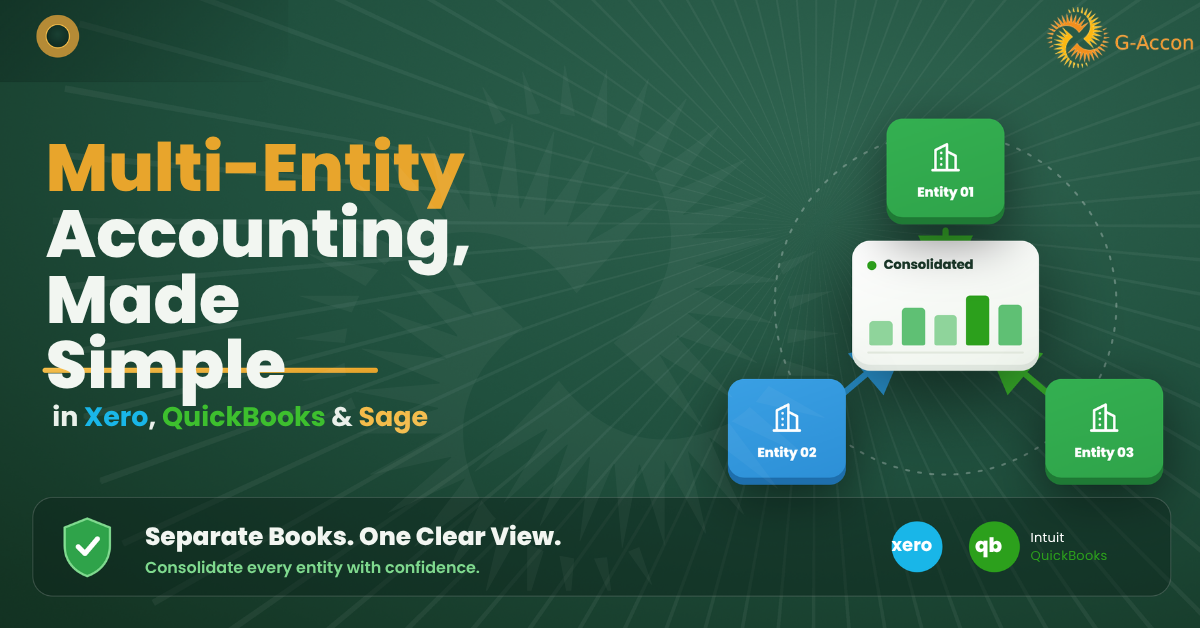
Multi-entity accounting is the process of managing financial records for two or more separate entities while also producing a consolidated view of the wider business.
An entity can be a subsidiary, branch, location, franchise unit, real estate LLC, project company, regional office, or separate legal company under shared ownership. Each one may need its own books, bank accounts, tax records, reports, and compliance process.
But leadership usually needs more than separate reports. They want to see the whole business clearly. They want to compare entity performance. They want a consolidated profit and loss. They want to know which entity is carrying costs, which one is generating cash, and which one needs more attention.
That sounds simple until you start bringing the numbers together.
Multi-entity accounting has to do two things at once. It has to keep each entity’s records clean and separate. And it has to roll those records into a broader report that makes sense as a single business.
This is where consolidation comes in.
The IFRS Foundation explains that consolidated financial statements present the assets, liabilities, equity, income, expenses, and cash flows of a parent and its subsidiaries as one economic entity. IFRS 10 also explains that intragroup assets, liabilities, equity, income, expenses, and cash flows are eliminated in full during consolidation.
In simple terms, a consolidated report should show the group as one business. It should not double-count activity that happened between entities in the same group.
How Multi-Entity Accounting Differs From Single-Entity Accounting
The easiest way to understand the difference is to look at what finance teams have to manage in each setup. Single-entity accounting keeps the work inside one company file. Multi-entity accounting adds more moving parts, because the team has to keep each entity accurate while also creating one clear view across the group.
| Area | Single-Entity Accounting | Multi-Entity Accounting |
| Business structure | Covers one company or legal entity | Covers two or more entities, subsidiaries, locations, branches, or business units |
| General ledger | Usually has one general ledger | Each entity may have its own general ledger |
| Chart of accounts | Uses one chart of accounts | Each entity may have its own chart of accounts, which may not match the others |
| Reporting focus | Shows what happened inside one company | Shows what happened inside each entity and across the whole group |
| Currency and rules | Usually follows one currency and one main reporting structure | Entities may use different currencies, tax rules, or reporting requirements |
| Manual work | May include transaction cleanup, invoice review, and account checks | Often includes account mapping, intercompany eliminations, report consolidation, and cross-entity checks |
| Main challenge | Keeping one company’s books accurate | Keeping each entity accurate while also creating a trusted consolidated view |
| Reporting risk | Errors usually affect one company’s report | Errors can affect entity-level reports and the consolidated group report |
| Example issue | An expense is posted to the wrong account | The same expense category is named differently across entities, making consolidation harder |
| Bottom line | The structure is usually straightforward | It is not just more bookkeeping. It is a different reporting challenge |
Why Multi-Entity Accounting Gets Messy
Multi-entity accounting rarely becomes difficult overnight. The problems build slowly. Two entities may still be easy to manage with a few extra spreadsheet tabs.
Three may feel fine, too. But once the business grows to five, ten, or more entities, the same workaround starts to crack.
The issue is not that the finance team lacks skill. Most times, the process was simply not built for that much data, variation, and review work.
One common problem is the chart of accounts.
One entity may use “Software Expense,” another may use “Apps and Subscriptions,” while another puts the same cost under “Office Expense.” Each file may look fine on its own, but consolidation needs clean comparisons.
Someone has to map those accounts, check for new ones, and make sure each cost rolls into the right place; and a small mapping error can make one entity look more profitable than it really is.
Intercompany activity adds another layer.
One entity may pay a shared bill, charge another entity, or record a management fee. Those entries may be correct inside each company, but they usually need to be removed from consolidated reports. When one side records the transaction, and the other side does not, someone has to chase it down.
Spreadsheets can also become too important.
Google Sheets and Excel are useful because they are flexible, but they become risky when one workbook holds all the formulas, mappings, and manual fixes. One pasted row in the wrong place can quietly change the report.
Then reports arrive late.
By the time leadership gets clean consolidated numbers, the business may already be making decisions from old dashboards or partial updates.
Good multi-entity accounting does not remove careful review. It removes the repeated manual work that slows the team down.
Which Businesses Need Multi-Entity Accounting?
Any business with two or more entities may need multi-entity accounting, but the pain shows up differently depending on the structure.
A real estate group may hold each property in a separate LLC. That gives owners and lenders a clean view at the property level, but leadership still needs a portfolio-wide picture.
A franchise group may need location-level reporting for each unit, but it also needs to compare sales, payroll, margins, and operating costs across the group.
A construction company may create separate entities for projects, regions, or ownership structures. The finance team may need job-level reporting, entity-level statements, and consolidated reports for lenders or partners.
A healthcare group may operate several clinics or facilities under separate billing or legal structures. Each site has its own performance, but leadership still needs one view of revenue, cost, cash, and profitability.
Accounting firms and bookkeeping practices face a slightly different version of the problem. They may not be consolidating all clients into one group, but they still manage many reporting workflows across many company files. They need repeatable templates, scheduled refreshes, clean reporting packs, and a reliable way to manage data without rebuilding every client report from scratch.
In all of these cases, the core challenge is the same. Separate books need to stay separate. But the reporting still needs to come together.
What Multi-Entity Accounting Software Should Actually Do
A good multi-entity accounting software should reduce the work that keeps repeating every month.
That sounds obvious, but it is easy to forget during a software search. Teams get pulled into feature lists, demos, dashboards, and big claims about automation. But the real test is simple.
Does this tool remove manual work from our actual close and reporting process?
The first job is consolidation. The software should help consolidate financial data from multiple entities into a single, clear view. That may be a consolidated profit and loss, balance sheet, cash flow report, trial balance, or management dashboard.
The second job is account grouping. If different entities use different account names, the reporting layer needs a way to group similar accounts into one clean structure. This is what makes a fair comparison possible.
The third job is handling intercompany activity. If entities trade with each other, lend to each other, or allocate costs between themselves, those transactions need to be handled carefully. The process should be repeatable, not rebuilt by hand every month.
The fourth job is keeping reports current. A dashboard that relies on someone exporting a report every Friday isn’t truly automated. Scheduled refreshes matter because they remove one more fragile step from the process.
The fifth job is giving the team confidence. Finance teams need to trace numbers back to the source. They need to know where the data came from, when it was refreshed, and how it was grouped. Without that, even a beautiful report can become hard to trust.
Do You Need a Full ERP?
Some multi-entity businesses do need a full Enterprise Resource Planning (ERP). If the current accounting system can no longer support the business, an ERP may be the right move. That is especially true when the company needs deeper operational controls, inventory management, procurement, approvals, revenue rules, entity governance, or stronger accounting architecture across the whole business.
But a painful reporting process does not always mean the accounting system is broken.
Sometimes QuickBooks, Xero, Sage, or FreshBooks is still doing the core accounting job well. The issue is what happens after the data is recorded. The team still has to export, clean, map, consolidate, format, and refresh reports manually.
That is a reporting layer problem.
And solving a reporting layer problem with a full Enterprise Resource Planning (ERP) can be too much. It may take more time, more budget, more training, and more internal change than the team actually needs.
This is where growing companies should slow down and ask the honest question. Are we replacing the accounting system because it is the problem, or because our reporting workflow has become painful?
Where G-Accon Fits
G-Accon is useful when your accounting system still works, but your reporting process is too manual.
It connects QuickBooks, Xero, Sage, and FreshBooks with Google Sheets, so finance teams can pull accounting data into spreadsheets, refresh reports, build dashboards, and manage multi-entity reporting without replacing their core accounting software.
For QuickBooks users, G-Accon supports two-way sync, automated reports, dashboards, data refresh, and multi-entity consolidation. For consolidation work, it supports intercompany eliminations, multiple currencies, account mapping, account grouping, filtering, scheduled refreshes, secure sharing, and formatted reports in Google Sheets.
That makes it a practical fit for teams that want to keep using spreadsheets, but not the manual exports, stale data, and fragile formulas that often come with them.
For CFOs, this can mean faster consolidated reporting. For bookkeeping firms, it can mean reusable client reporting templates. For accounting teams, it can mean fewer manual steps at month-end.
G-Accon is not a full ERP replacement. If the business needs a new ledger or a broader ERP, another system may be a better fit. But if the books are fine and reporting is the bottleneck, G-Accon gives teams a cleaner way to work.
What a Better Multi-Entity Workflow Looks Like
A better multi-entity workflow starts with one simple change: connect each entity’s accounting data directly to Google Sheets instead of rebuilding reports from manual exports.
Once the data is connected, finance teams can pull the reports and transaction details they need for management reporting, consolidated financial statements, and entity-level review. Then accounts can be grouped into a structure that makes sense across the business, while intercompany activity can be reviewed and eliminated more consistently.
The biggest difference is that reports no longer need to be recreated from scratch every month. Instead of exporting files, pasting data, checking tabs, and rebuilding dashboards, the team starts with connected reports that can be refreshed on a schedule. That gives finance more time to review the numbers, spot issues, and explain what is happening across the business.
A better workflow does not remove the need for careful review. It removes the repeated manual work that keeps slowing the team down.
How to Choose the Right Multi-Entity Accounting Setup
Choosing the right setup starts with a plain question.
What are we trying to fix?
If the core accounting system cannot handle the business anymore, then look at ERP options. If the month-end close is slow because tasks, reconciliations, and approvals are scattered, close management software may help. If reporting and consolidation are the main pain, then a reporting automation layer may be enough.
This is where teams using QuickBooks, Xero, Sage, or FreshBooks should be careful.
It is easy to think that more complexity always requires a bigger system. Sometimes it does. But sometimes the better answer is to keep the system that already works and connect it to a stronger reporting process.
Before choosing a tool, ask how it handles the work your team actually does.
- Can it connect to your current accounting software?
- Can it pull the right entity-level data?
- Can it group accounts properly?
- Can it support intercompany eliminations?
- Can it handle multiple currencies if needed?
- Can reports refresh automatically?
- Can your team keep working in Google Sheets?
- Can you trace numbers back to the source?
- Will it make the process easier next month, not just look good in the demo?
That last question is the one that matters most.
The Bottom Line
Multi-entity accounting is not just accounting with more company files. It is the work of keeping each entity accurate while giving the business one clear view of performance. That gets harder as entities grow, charts of accounts drift, intercompany activity increases, and reports become more dependent on manual spreadsheets.
Some businesses will need a full ERP to fix that.
But many will not.
If your accounting system still works, and the real problem is reporting, consolidation, and data movement, then replacing everything may be the wrong first step.
A better reporting layer can give your team the clarity it needs without forcing a full system change.
G-Accon was built for that kind of finance team. It connects QuickBooks, Xero, Sage, and FreshBooks with Google Sheets, helping accountants, bookkeepers, CFOs, and finance teams consolidate entities, automate refreshes, group accounts, handle reporting workflows, and keep using the spreadsheet environment they already know.
For growing businesses, that may be the practical upgrade.
Not a bigger system for the sake of it.
Just a cleaner way to bring the numbers together.
Frequently Asked Questions
What is multi-entity accounting?
Multi-entity accounting is the process of managing financial records for two or more separate entities while also creating consolidated reports for the wider business group.
Why is multi-entity accounting difficult?
It becomes difficult because each entity may have its own chart of accounts, general ledger, currency, reporting rules, and intercompany activity. When those records are consolidated manually, the work can become slow and risky.
What are intercompany eliminations?
Intercompany eliminations remove transactions between related entities from consolidated financial statements. This helps prevent internal activity from being counted as external revenue, expense, receivable, or payable.
Does every multi-entity business need an ERP?
No. Some multi-entity businesses do need an ERP, especially if the accounting system itself no longer supports the business. But if the main issue is reporting and consolidation, a reporting automation tool may be enough.
Can Google Sheets be used for multi-entity reporting?
Yes. Many finance teams use Google Sheets for multi-entity reporting because it is flexible. The risk comes when the process depends on manual exports and pasted data. Tools like G-Accon help by connecting accounting data directly to Google Sheets and refreshing reports automatically.
How does G-Accon support multi-entity reporting?
G-Accon connects QuickBooks, Xero, Sage, and FreshBooks with Google Sheets. It supports multi-entity reporting, intercompany eliminations, account grouping, multiple currencies, scheduled refreshes, and automated reporting workflows inside Google Sheets.